Slice recording Bass tracks for STW
I had said on a previous post, that I would further explain my limited knowledge of amp mikeing. mikeing is an art form in it’s own way. There are a number of techniques and user specific trick but at the end it relies on a trial and error procedure and your own ear.
Before I start, I have my way of doing things. This is my personal approach, it is not a silver bullet and please do not take it as rules to follow, just use it as an ideas to investigate your own way on.
 a Mix with several guitars most via miced amp.
The first thing when mikeing an amp is to know what you are after. This requires that you have spent time with the artist and the producer and understand what it is they are looking for or better said listening for. I am going to narrow this post to guitar amps, but the same is true with almost any other instrument that may be amped.
It is impossible to set a rig up in any way if you don’t have a target, make sure you know all the parts that are going to be recorded and what tone and quality you are out to nail. There are normally a few things that are a given and you don’t have much influence on. The instrument, what guitar is going to be used is a very personal choice, and the relationship artist vs. instrument is almost a religious one. to a similar extent amps and stomp boxes or effects are also mainly artist chosen.
 Brian May
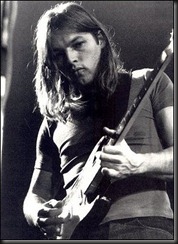 David Gilmour
 Eddy Van Halen
So how can you contribute to the sound. Well that is a no brainer, when something comes out of the amp it needs to be captured and in the capturing lays the secret. A bad mikeing and recording can ruin the best performance/guitar/amp combination and turn it in to noise. and in the same way a good mikeing and recording can bring trough another way's mediocre take. Needless to say joining the best of both, will deliver a spectacular track.
It seems there are some boundaries that we don’t want cross, but who say’s we can’t provide some advise and tips to the artist, that may help us in our job of getting it right.
First ask what choices of guitar he wants to use or has available, the same with the amp. Ask him to do a test track for each guitar (you won’t usually have to do this, they will request this them self’s, specially if they are accustomed to working in studio). To record the tests ask him if you can rig all the different amps he is thinking of (again this may not be needed) and if you have any specific amps available that you may think are suitable for the sound you are after and ask him if it is ok to mike them up also for the test. Who knows a blend may be just the right thing to get the ultimate tone. Get him to play around and listen to the different amps in the room, move them around until he is confortable. Try to avoid that he puts them to near any wall
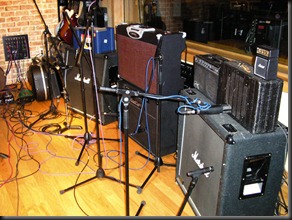 Amp array for test. Picture not mine
Let the artist to review all the recorded tracks for all amps separately and in different blend combinations. use your own ear to find sweet spots or problems an point them out to him.
Once he has settled on a number of amps (there is no limit other than common sense). you need to have studied the room you are going to record in. Share with him what areas suit the sound he is after the best. As a rule I keep all amps at least 1 or 2 feet form a back wall. Spend some time looking into the ambient sound of the room. Depending on what he is looking for you may or may not need an ambient mike so make sure you find the spots in the room that serve a good ambient and don’t mud up the sound. Highly saturated guitars in my experience don’t win much with an ambient mic, there are too many harmonics that the ambient resonance is not quite clear. In contrast clean sounds are greatly enhanced if you have a good ambient mic.
now we have the amps in place it is time to mic. I usually start one amp at a time and one mike at a time. I first work on the close up mic’s setting them at about one inch from the grid.
There are several standard locations for mikeing based on the distance of the mike form the cab’s grid. In the following figure I have label mike positions A through E
 mike positioning
Position A is a close up mick flush the grid. Position B is a mike 1 or 2 inches from the grid. Position C is between 1 or 2 feet from the grid. Position D is further than 6 feet from the grid. Position E is an open back and mike is generally 0 to 6 inched form the open back.
Positions A & B are close up mikeing positions and will capture only speaker info depending on the mike choice, Positions C & D are ambient mike's with the difference that C will produce a tighter room image than D. Finally E will depend on the amp type, D is great to recording fat sounding guitar. The norm and needles to say this is choice, is to have 1 or 2 close up mike's and one ambient mic.
As we have said already ambient mike positioning depends on the ambient characteristics of the room. how ever close up mike's have a full array of different positions and settings that have to be experimented with. In general there are 3 positions to place the mike in front of the speaker. from the outside inwards as shown on the figure bellow.
 mike placing
The position further away from the centre is called the rim, the sound captured here is darker with greater amount of low and mid lows. On the cone or second position, the sound mellows up a bit and gets brighter. On the dust cap or centre of the speaker the sound is much brighter and losses some of the low frequencies retaining the mid lows. placing can be in any position you like but these are the three most common.
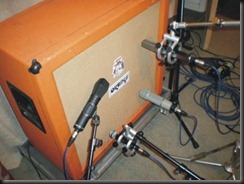 mike testing
Warning! when using two mike's in a close up configuration on the same cab or speaker, the distance form the grid should be equal and if by choice you use different separations you will have to check for phase issue. Bare in mind that a phase issue can render on of the mike recordings useless. how ever there are plugins that can help solve the problem.
 Possible phase issues.
When placing a close up mike there are two ways you can position your mike in front of the speaker. Head on or off axis. In the head on configuration the mike is place perpendicular to the speaker at a 90º angle from the grid. The other configuration requires that the mike be at an angle between 30º and 60º form the grid (Note this applies basically to cardioid pattern mike’s).
It is paramount that you experiment with different settings and configurations, testing all positions and different mike choices. Never walk away from an amp and start recording without checking for as long as necessary for the tone you are looking for. This process may be very time consuming but will save lots of time and money later. It is best to do all this process before the artist arrives and save him from going through the hole thing. It is very lightly that the artist will want a twitch here and there but the Core has been done without him being there. they tend to get inpatient.
Microphones, this is a subject in it’s own and I don’t intend to extend on this topic here, but it is important that you understand the different patterns that they correspond to. In the figure bellow we have an example of the three basic patterns. A Cardioid, B Omnidirectional, C Bidirectional.
 mike Patterns
When used for recording an amp Cardioid is the predominant choice in the industry, however when recording ambient it is often a omnidirectional mike that is preferred. Unless certain reflections or room noise bleeding into the mike produce un wanted result. A Cardioid mike will capture sound coming in from the front of the mike and will filter out other sound coming from different sources. while a Omni will record 360 degrees around in all directions including sound coming from behind the mic.
Finally the consideration of the amp volume. it is best to get the sound from the amp without over saturation. This will require that the artist understand that a balanced output from the cabinet is fundamental for a good capture, it cant be too low or too loud (obviously depending on the desired result).
As I said at the beginning there is only one way trial and error, you have to try and try and try again until you get what you are looking for. I assure you that the result is worth the wile.
Thanks for reading and I really hope you enjoyed.
follow slice at http://youtube.com/user/inside71slice
© Ian Burt 2012